
July 2026 has been the month with the world’s seas hitting their hottest surface temperature on record (The Guardian, 2026). Record high sea surface temperatures (SSTs) were measured in the Atlantic along the European coast and in the Western Mediterranean (Copernicus, 2026), and SSTs were as much as 6°C hotter than normal in the Mediterranean in June (European Union, 2026).
These extremely high SSTs have had strong impacts on marine ecosystems. In the UK, fishermen have reported an increase in octopuses in their waters, with numbers recorded since April 2026 raising particular concern (Gov.uk, 2026). The movement of marine species northwards into cooler waters is also being observed across European seas, with potential implications for native species (Independent, 2026, Irish Examiner, 2026). These shifts in marine species distributions may affect the range of fish and crustaceans available for human consumption and aquaculture. Changes in marine food webs have also been observed, with dolphins reportedly feeding on jellyfish as the availability of their usual prey, such as mackerel, declines (BBC, 2026).
As people increasingly use beaches to cool down during land-based heatwaves, changes in marine conditions may also have implications for human health. The European Centre for Disease Prevention and Control (ECDC) has warned of an increased risk of water-borne diseases such as vibriosis during sustained periods of high temperatures (ECDC, 2026). In addition, increases in jellyfish abundance have been linked to changing marine conditions, including the expansion of low-oxygen zones in which jellyfish can thrive relative to some fish species. This can have implications for coastal tourism, particularly where high jellyfish concentrations result in beach closures (Calbert, 2025).
More broadly, warmer seas cause warmer air and elevated humidity for coastal regions. This in turn has a direct impact for coastal communities via elevated temperatures, particularly night time minima, and increased humidity exacerbating heat stress. Increased evaporation from the warm seas also leads to increased moisture levels in the atmosphere which may fall later in the season as intense rainfall events.
Researchers from Switzerland, Sweden, the United States, Ireland, and the United Kingdom collaborated to assess the extent to which human-induced climate change altered the likelihood and intensity of the extreme SST conditions along the European coasts in July. This year’s high SSTs have been remarkable not only in their intensity, but also in how early in the year they were reached. To account for these characteristics, we use two different temporal event definitions: the warmest 14-day period within a year, as well as the warmest 14-days within any given July. We look at four different regions that saw particularly high SSTs this year (so far), see Fig. 1:
- Celtic: Comprising the Irish Sea and St. George’s Channel, Celtic Sea, English Channel, Bristol Channel, Inner Seas off the West Coast of Scotland, plus an extension west from these defined regions to 15°W between 48°N and 59°N.
- Bay of Biscay and Iberian Peninsula (BIP): Comprising the Bay of Biscay plus an extension west to 14°W between 36°N and 48°N.
- West Mediterranean (WMed): Comprising the Western Mediterranean Sea Basin, Alboran Sea, Balearic (Iberian Sea), Ligurian Sea and Tyrrhenian Sea.
- East Mediterranean (EMed): Comprising the Eastern Mediterranean Sea Basin, Adriatic Sea, Ionian Sea and Aegean Sea.
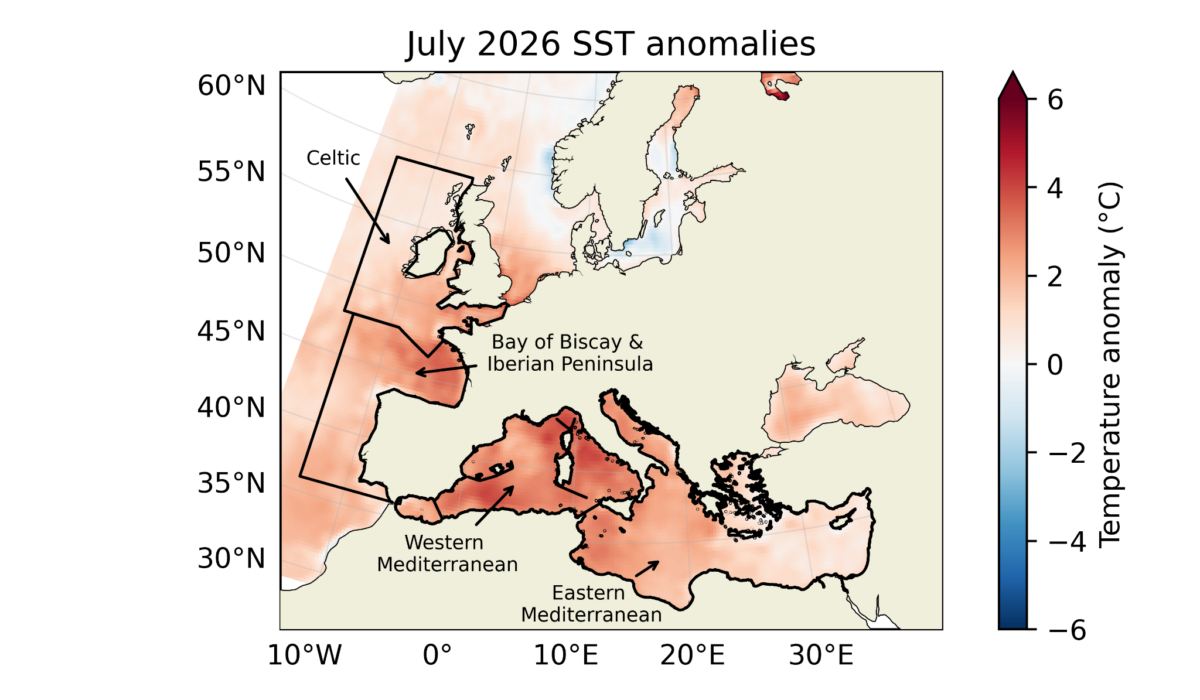
Figure 1: Anomalies (i.e., departures from normal) in July 2026 sea surface temperatures around Europe with respect to the 1990-2020 climatological average for July. Data: OISST NOAA.
Main findings
- Extremely high SSTs and marine heatwaves have disastrous consequences for marine ecosystems, leading to mass mortality events of habitat forming species such as corals, sponges and macroalgae. The loss of such foundation species impacts the structure and function of the entire ecosystem. Mass mortality events caused by extreme heat can thus lead to mass mortality events further down the food chain for invertebrates, fish, seabirds and marine mammals.
- Marine heatwaves can make local conditions increasingly unsuitable for marine species adapted to historical temperatures, driving species range shift, changes in community composition and the replacement of species by more warm-adapted organisms. These impacts can be particularly pronounced for benthic and demersal species, which have limited ability to move to more suitable temperatures, making seafloor ecosystems especially vulnerable to warming and heat extremes.
- The impacts are not exclusively ecological. Global research has shown that high SSTs can influence regional climate phenomena, including monsoon rainfall, and can interact with tropical cyclones, potentially making them more destructive. For Europe, high Mediterranean temperatures have, for example, been linked to the extreme rainfall events such as the Valencia floods in 2024.
- When assessing observational datasets of SSTs, we find that this year’s event is not a rare event in today’s climate, in which the planet has warmed by 1.4°C, with return periods ranging from approximately 1 year in the Eastern Mediterranean to 5 years in the Western Mediterranean for the annual warmest 14-day period (SST14x) event.
- For the warmest 14-day period (SST14x) July events, the return times are quite different between different datasets, and in some of them much rarer than the annual event, with a return period of up to 90 years in the Bay of Biscay and Iberian Peninsula (BIP) region.
- As expected, there are strong trends in SSTs across all four regions and for both temporal definitions. The Celtic region shows the smallest change, with temperatures increasing by 1.2°C. The probability ratio is approximately 30, suggesting that this would have been a roughly 1-in-100-year event in a climate 1.4°C cooler. In the three other regions, the SST14x values observed would have been virtually impossible in a pre-industrial climate. Observations suggest that temperatures in the BIP region have increased by 1.5°C, compared with 3.1°C in the WMed and 2.6°C in the EMed. The increases in the latter two regions substantially exceed the level of global warming.
- Focusing specifically on SST14x during July, we find for all regions July exhibits the fastest rate of change compared to the annual SST14x and observations indicate that these July events would have been virtually impossible in a pre-industrial climate, while the change in intensity ranges from 1.5°C in the Celtic region and 3.4°C in the Western Mediterranean.
- We also assessed the rate of change in all calendar months, finding that the rate of change in SSTs is strongest in the summer months, and especially in the Mediterranean far exceeding global warming. The shoulder months, especially in spring, also show a warming much greater than the global average.
- To assess whether all of the observed warming is attributable to human-induced climate change, we combine observations and climate models for the annual SST14x event. We find that, in the Celtic region, climate models and observations show very similar trends, while in all other regions the observed trends are much stronger than those simulated by climate models. Despite this, we find that in the two Mediterranean regions, the increase in warming attributable to human-induced climate change is about 2°C, substantially surpassing the level of global warming, even under this conservative estimate. BIP follows global warming very closely, with an attributable increase in intensity of 1.4°C, and a slightly smaller increase of 1.3°C in the Celtic region. In all four regions, these events would have been very rare in a 1.4°C cooler climate despite being common today.
- When analysing the same regions and events but for a 1.4°C warmer future (2.8°C since pre-industrial, the current warming level expected at the end of this century) we find the changes in intensity to continue at a similar rate, so that the events observed in 2026 would be another 1.3°C to 1.9°C hotter.
- In addition, we analyse the role of climate change in the frequency of marine heatwaves, defined as exceeding the local 90th percentile threshold from the 1982-2011 climatology for at least five days. We find that in the Celtic region 80% of the area experienced MHWs compared to only 30% in a 1.4°C cooler climate, in the BIP region the change is from only 40% to 90% today, in the Western Mediterranean the change is from 40% to 80% while in the Eastern Mediterranean only 9% of the area would have experienced heatwaves in a 1.4°C cooler climate compared to nearly 70% today.
- Our results projecting the intensity of such events in a warmer climate exhibit temperatures above what many species living in our seas today can tolerate, showing strong limits to adaptation. Thus, a rapid transition away from fossil fuels is essential to save crucial ecosystems, fisheries, food production and tourism along the European coasts.
- Adaptation to increasing marine temperatures can increase resilience and reduce vulnerability, but cannot fully offset the ecological impacts of continued ocean warming. Adaptation measures can include reducing additional pressures on marine ecosystems, protecting habitats, adapting fisheries and aquaculture management, and improving monitoring and early-warning systems.