
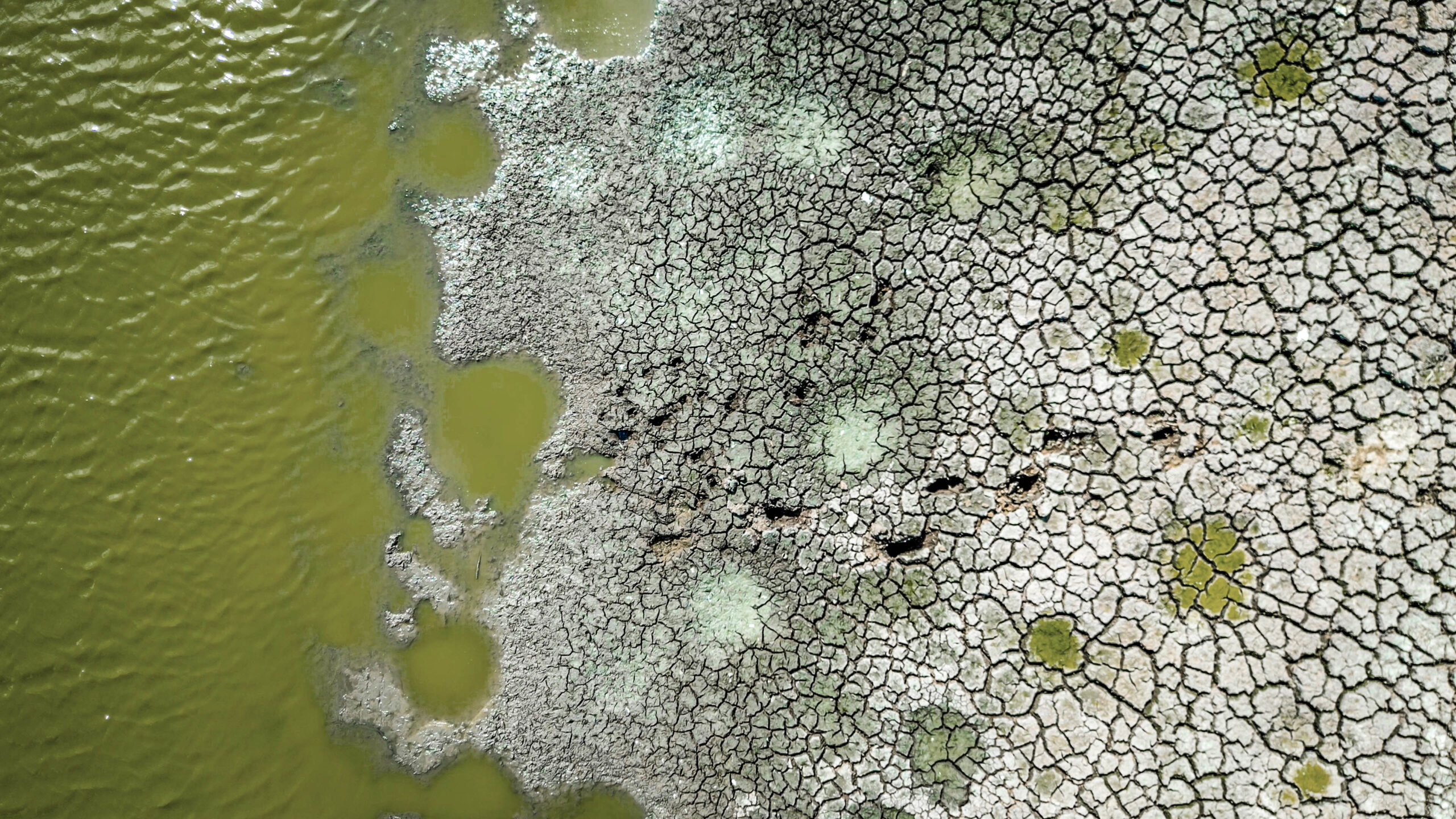
Since May 2026 Puerto Rico, Jamaica, and smaller islands including St Lucia, St Vincent, the US Virgin Islands, Grenada and St Kitts have experienced increasingly severe drought conditions, following a wetter-than-normal late winter and early spring (Drought.gov, 23 July, 2026). Persistent rainfall deficits and near-record temperatures have driven critically low river flows, declining reservoir and groundwater levels, and increasing water shortages (Caribbean National Weekly, 2026). Puerto Rico has introduced water rationing for some residents in addition to agricultural use, while more than 300 brushfires were recorded in July. In the U.S. Virgin Islands, water shortages are affecting households and farmers, while Jamaica has imposed restrictions on non-essential water use in several parishes as major reservoirs fall to low levels.
The drought conditions are putting pressure on water supplies, agriculture, food security and livelihoods, while also increasing wildfire risk (US drought monitor). While not a driver of the current conditions, El Niño and Saharan dust are expected to further suppress rainfall and increase heat, potentially prolonging dry conditions and worsening water shortages, as the summer dry season continues (PBS, 2026).
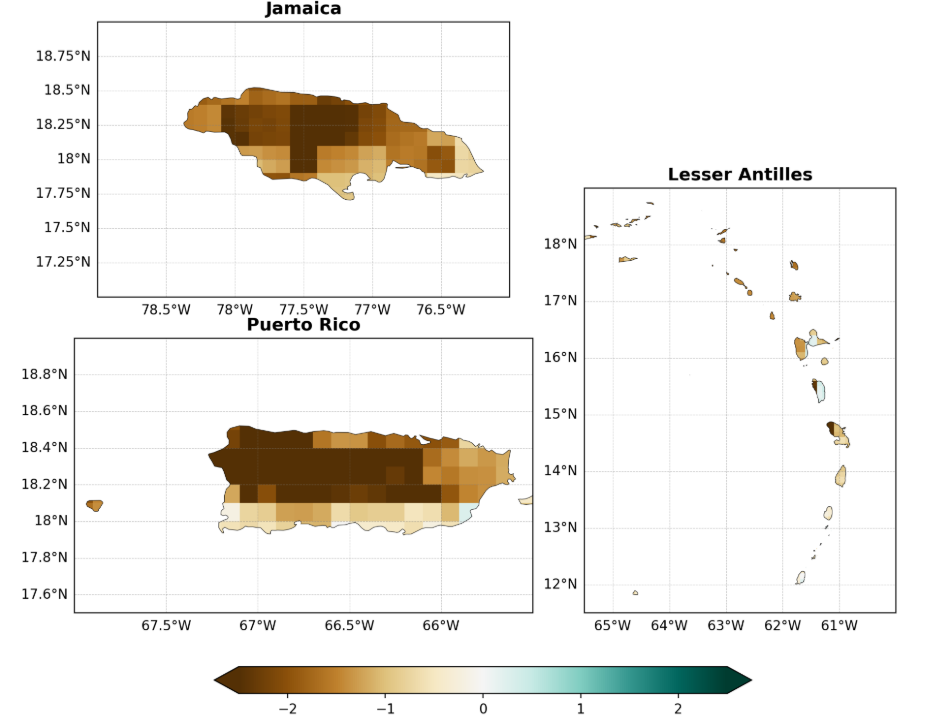
Researchers from Jamaica, the Dominican Republic, Ireland, the United States, the Netherlands, Sweden and the United Kingdom used established, peer-reviewed methods to assess whether, and to what extent, climate change influenced the Caribbean drought, focussing on Puerto Rico, Jamaica and the Lesser Antilles, where drought conditions are worst.
Drought can be defined in several ways. Meteorological drought is characterised by below average rainfall. In contrast, ecological drought occurs when a lack of rainfall or dry soil affects farming and crop growth. It is defined as a measure of soil moisture or by estimating the balance between rainfall and evapotranspiration over time. As increased evapotranspiration driven by regional warming can substantially intensify drought impacts, we separately assess the contributions of both low rainfall and effective precipitation. Effective precipitation is defined as the rainfall subtracted by potential evapotranspiration (PET – the amount of evapotranspiration that would be seen assuming unlimited surface water availability; note this is different from actual evaporation.) and a measure for the water that is available for plants and soils. We focus on the three months, May, June and July, as the temporal extend.
Main findings
- Caribbean vulnerability to drought results from the convergence of several compounding factors. Small island territories are naturally limited in freshwater resources and storage, increasing their vulnerability to droughts. These environmental challenges are intensified by human and tourism demands, which vary with tourism seasons, urban growth, and agricultural needs. Outdated water infrastructure, especially vulnerable drinking water systems with high leakages, worsen shortages during droughts.
- Droughts have wide-ranging impacts on agriculture including increasing crop stress, reduced yields, and reduced pasture and forage availability for livestock. Limited land on small islands means that farmers have few alternative options and often resort to expensive imported feed or selling livestock to cope. This can also contribute to food insecurity on islands that already have very high food costs.
- Before estimating any trends in the observations, we tested the influence of natural variability, comparing the performance of ENSO, NAO and AMV as covariates – all of which are known to influence Caribbean seasonal precipitation. Across regions, the December-February (DJF) NAO best improved model performance.
- Drought conditions differ across the three regions in terms of rarity, with the rarest low rainfall event of 50 years in Puerto Rico. Conditions were also rare in Jamaica with a 30 year return period.
- Warmer temperatures increase drought severity due to higher evaporation, with this year’s seasonal temperatures observed to have been extremely rare before human-caused climate change. We account for this using effective precipitation, the total rainfall minus the evaporation we approximate would occur with unlimited surface water availability. May to July effective precipitation was a 15 year event in Puerto Rico, and a 30 year event in Jamaica.
- In Jamaica, observations showed a decreasing trend in both May-July actual precipitation and effective precipitation, but the strength of the decrease depends on the dataset. In Puerto Rico, a decreasing trend is observed in early wet season precipitation (pr-MJJ) and in one of the datasets for effective precipitation (eff-pr-MJJ), and is not as strong as in Jamaica. Stations from Puerto Rico show a spatially diverse trend, with strong decreases in precipitation in some regions but not in others.
- In order to assess the role of human-induced climate change in the observed drying, we combined observational data sets with climate models. In all cases, the climate models do show a small, but consistent, drying. For Jamaica, combining models and observations shows a decrease in rainfall of about 6% due to human induced climate change. An event with similar low effective precipitation as observed in 2026 is now 40% more likely compared to a 1.4°C cooler climate. For Puerto Rico the picture is very similar, with a decrease in rainfall of about 9% and an effective precipitation event that is now about 30% more likely than in a pre-industrial climate.
- We also analysed the Lesser Antilles, though sparse weather stations and the small size of the islands meant that results were highly uncertain, a minor wetting trend was seen in observations and minor drying trend in models.
- Across all regions, modelled trends were stronger with a further +1.4°C warming. Jamaica, Puerto Rico and the Lesser Antilles were all projected for an event this rare to have a further 10% lower rainfall. The effective precipitation event was projected to increase in likelihood by 3 times in Jamaica, and 2.5 times in Puerto Rico.
- Early wet season rainfall is a critical recharge period for Caribbean islands, with deficits possibly resulting in long term socioeconomic impacts on agriculture and tourism. Low early season rainfall exacerbates vulnerability, such as landslides with heavy rainfall or higher severity if drought conditions continue.
- Long-term Caribbean water sector adaptation combines modern monitoring, infrastructure and technologies such as desalination and rainwater harvesting, with long-established Indigenous and local knowledge such as seasonal water rationing, and place‑based watershed stewardship. Although some components of an integrated approach to water sector management are already in use, e.g. Jamaica’s expanding water monitoring system, key practices such as rainwater harvesting are underutilised relative to their potential. Water sector mitigation and adaptation may be strengthened across the region by scaling up local or decentralized water solutions and formally incorporating traditional knowledge and practices into water resource governance, planning, and resilience strategies.
| The North Atlantic Oscillation (NAO) was used as a covariate in this study. The NAO affects Atlantic weather through altered pressure patterns influencing the position of the jet stream and direction in which weather systems travel. The winter value (December to February) is most commonly used in climatological analysis, and was found to be most predictive of early wet season rainfall in this study. This winter’s value was neutral, so whilst used as a covariate its effects are not emphasised in this study. It should be noted that the March value of the NAO was very high, and whilst we assessed the effect of the spring (March to May) NAO and found it less predictive – the high value this year may have had some influence not assessed in this report. |