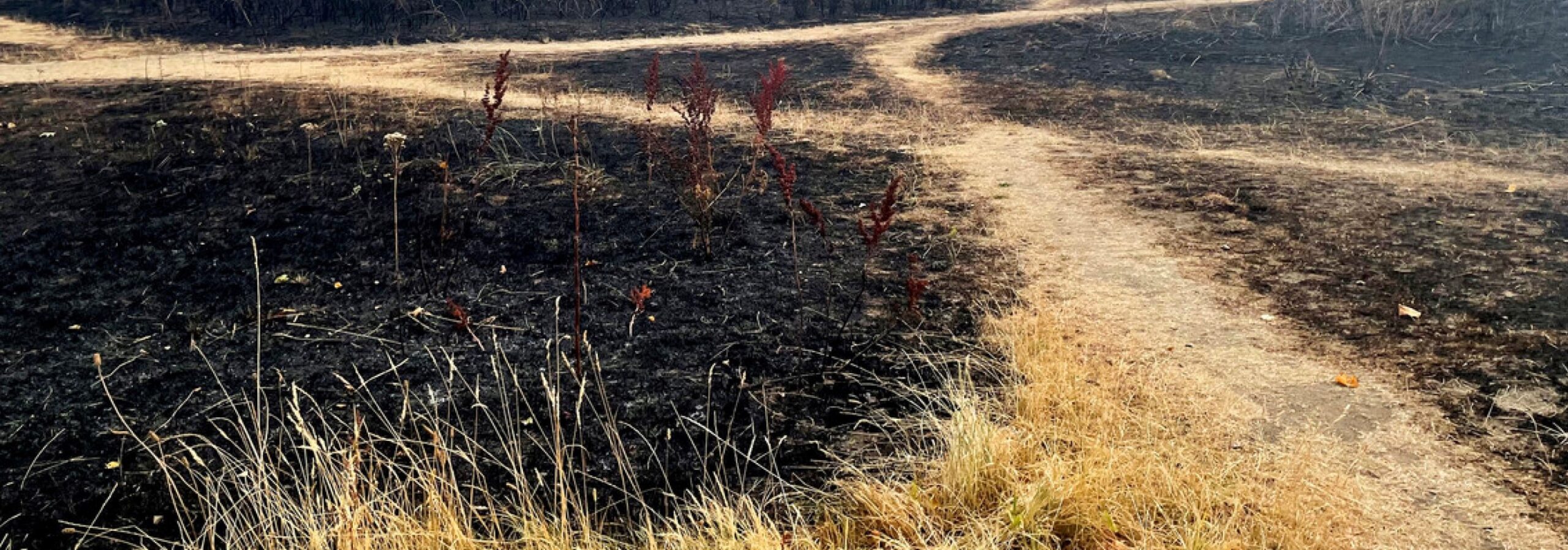

The European summer of 2026 has so far been characterised by exceptional heat and widespread dryness (Copernicus, 2026). Between April and June, large parts of the continent, from Portugal in the southwest to southern Finland in the northeast, received below-average rainfall. Combined with successive heatwaves, these conditions have intensified drought across Europe, contributing to widespread agricultural and hydrological impacts, unusually low river levels (NOS, 2026), and severe wildfires, particularly in Spain and France, where 116,000 and 42,000 hectares have already been burnt, respectively (EFFIS, 2026). Although western Europe experienced a relatively wet start to the year, persistent precipitation deficits in eastern Europe carried over from 2025, resulting in different types and stages of drought developing across the continent. With forecasts indicating little relief in the near term, the summer of 2026 is emerging as one of Europe’s most significant heat and drought events in recent years.
Scientists from Austria, Germany, Hungary, Latvia, the Netherlands, Romania, Slovenia, Spain, Sweden, Switzerland, the Czech Republic, the UK, and the US used established, peer-reviewed methods to assess whether, and to what extent, climate change influenced the European drought.
Drought can be defined in several ways. Meteorological drought is characterised by below average rainfall, whereas agricultural drought occurs when lack of rainfall or dry soil affects farming and crop growth and is measured by soil moisture or by estimating the balance between rainfall and evapotranspiration over time. Because increased evapotranspiration driven by regional warming can substantially intensify drought impacts, we separately assess the contributions of both low rainfall and potential evapotranspiration (PET), as well as soil moisture. As the temporal extent of the drought is quite different in the western part of Europe compared to the East, we look at two different timescales: the 3 month drought in the western region and the 6-12 month drought in the eastern region.
| Drought drivers and metrics: Soil moisture is the primary measure of agricultural or ecological drought (Seneviratne et al., 2021), when a deficit in moisture affects vegetation growth and causes other adverse plant responses. It is driven by the combination of meteorological drought (defined as low precipitation) and high seasonal evaporation and transpiration. As well as being a function of humidity, evaporative demand increases exponentially with temperature (Allen et al., 1998), and is therefore sensitive to global warming. In addition, potential evapotranspiration (PET) is used to reflect the contribution of atmospheric aridity to drought, in lieu of Actual Evapotranspiration (AET). PET is an atmospheric-driven variable, and reflects the amount of evapotranspiration that would be seen assuming unlimited surface water availability, removing the need to account for aspects including spatially varying vegetation, soil texture and irrigation. Whilst both AET and PET respond strongly to warmer temperatures, the increase in AET is normally more limited than PET. This is due to the saturating effect of evaporative demand on actual evaporation as moisture availability is depleted, while highs in evaporative demand are responsive to stomatal closure – limiting actual transpiration (Grossiord et al., 2020). Climate models do not always capture these complex land-atmosphere feedbacks and vegetation responses accurately, which can lead to differences between real and simulated changes in AET. In this study we also provide direct information on trends in soil moisture, but as these are also affected by regional hydrological differences, we provide additional information in the form of the precipitation and potential evapotranspiration drivers. The unusually sunny conditions over parts of Europe in spring 2026 likely contributed to the observed soil moisture deficits though enhanced evaporation; we do not assess this contribution separately here. |
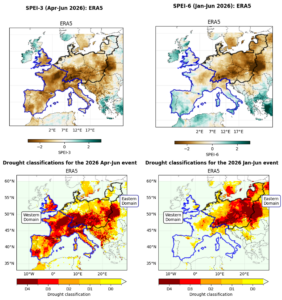
Fig: SPEI maps for 3- and 6- month accumulation periods ending in June 2026 over the region 33-60N,15W-30E. The Western Domain is highlighted in blue and the Eastern Domain is highlighted in black. Bottom: Drought classification maps categorised according to the US Drought Monitor (USDM) system. The categories are based on the n-month SPEI values in June 2026, calculated from ERA5 using the Hargreaves scheme for PET.
[CORRECTION: The SPEI maps for the 3-, 6-, and 12-month accumulation periods have been replaced with corrected versions on the website and the scientific report to correct for an error in the plotting routine. These maps are provided to illustrate the 2026 drought event. All analyses were performed using the correct data; therefore, no results, interpretations, or conclusions in the report are affected.]
Main Findings
- The European drought is a compound crisis, driven by prolonged precipitation deficits and extreme heat, with impacts already evident despite the summer only just beginning. Wildfire activity has also intensified rapidly in western Europe. The drought is placing severe strain on agriculture: historic crop losses, including France’s lowest maize harvest in 50 years and the loss of more than one million hectares of maize in Romania, combined with ongoing global conflicts, could drive up food prices and disproportionately affect low-income households. Many countries across Europe are already implementing emergency restrictions or temporary bans on non-essential uses of drinking water. At the household level, water rationing can create increased burden and financial strain, particularly for low-income households. At the same time, low river levels are disrupting cargo transport, while water scarcity is threatening energy production in hydropower-dependent regions.
- Soil moisture integrates the combined effects of anomalous rainfall and evaporation and is a key indicator of agro-ecological drought. In the western region, the April–June conditions are estimated to occur about every 5 years in the present climate. Synthesis of models and observation-based estimates suggests that such a soil drought has become about 5 times more likely than in a climate 1.4 °C cooler. The January-June soil moisture deficits across the eastern region are presently expected roughly every 15 years, and have become about 11 times more probable due to human-induced climate change.
- The low precipitation and high PET conditions were both relatively rare in today’s climate. For PET, the western region had an estimated return period of 50 years, and the eastern region of five years. For precipitation, the low rainfall was a 1-in-25 year event in the west, and a 1-in-30 year event in the east.
- Overall, the strong increase in PET based on observed data has shifted drought thresholds, such that rainfall deficits that would not previously have caused drought now result in drought conditions. For both study regions, climate change has increased the severity of the observed drought. The combination of low precipitation and high PET is characteristic of ‘extreme’ and ‘exceptional’ drought conditions in the Eastern and Western regions respectively, in today’s climate. An event of similar rarity would have resulted in comparatively milder ‘moderate’ and ‘severe’ conditions in a 1.4°C cooler climate, in the respective regions.
- In the western region, neither observations nor climate models show a long-term change in low April-June precipitation, suggesting that climate change did not play a role in the meteorological drought at the regional scale. However, for PET, both observations and climate models show strong increases over the region, leading to increasingly likely and intense agricultural and ecological drought. The synthesis of these lines of evidence suggests that such highly evaporative conditions as observed in April-June 2026 have become about 80 times more likely, or equivalently about 7% more intense.
- Over the eastern region, observed precipitation changes are sensitive to the timeframe considered. For the April-June period there is a drying trend, there is little long-term change over the 6-month January-June period, and the 12-month totals from July-June show a slight increasing trend. Considering the 6-month accumulations, climate models show an increase stronger than observed, suggesting an overall albeit statistically insignificant drying trend. On the contrary, trends in PET conditions are increasing strongly across all timeframes. For the 6-month totals, the synthesis of observations and climate models suggests that such highly evaporative conditions as observed during January-June 2026 have become about 40 times more likely, or equivalently about 8% more intense.
- With further warming of 1.4°C, in the western domain climate models project a slight decrease in precipitation for April-June, though this is likely not homogeneous across the region. Such intense PET conditions are expected to become around 10 times more likely, and the likelihood of such a soil moisture deficit is projected to double. In the eastern region, models project a further increase in 6-month precipitation, with such low totals becoming only around a third as likely as in today’s climate. However, warming is also expected to cause much higher PET, with a further increase in likelihood of a factor of about 2, and the likelihood of a January-June soil moisture deficit to increase by a factor of about 1.7.
- The results are aggregated across the selected regions and time periods. As a result, they may not capture local variability or shorter periods within individual regions. Consequently, the reported return periods, magnitude changes, and probability ratios apply to the aggregated indices and do not necessarily reflect local conditions.
- Across Europe, drought impacts are increasingly being managed through agricultural insurance, shock-responsive social protection, and emergency financial support. The EU has strengthened resilience by mobilising agricultural reserve funds to support farmers affected by climate-related drought and other extreme weather events.
- Drought response remains uneven across Europe. While the EU Water Framework Directive promotes sustainable water management, drought management plans are not mandatory, resulting in inconsistent preparedness across EU Member States. At the European level, a unified drought governance policy could help alleviate potential future drought impacts, alongside the Water Resilience Strategy.