
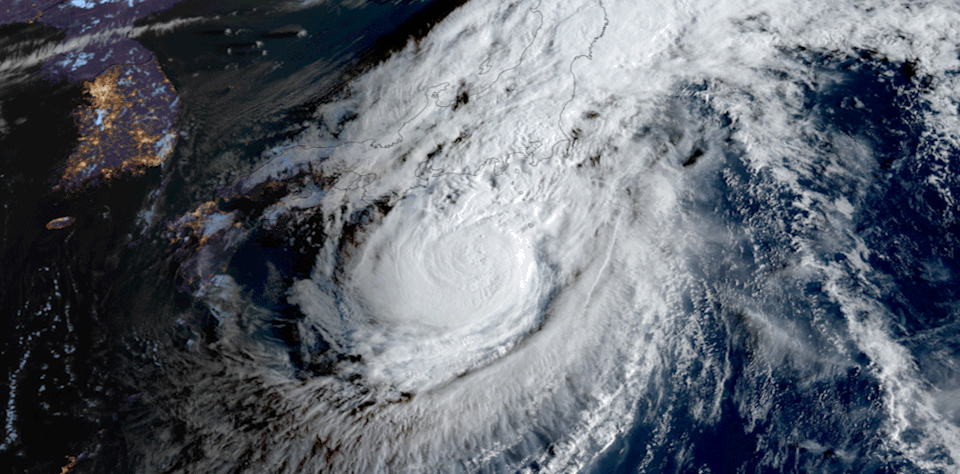
Typhoon Dujuan, the 25th typhoon of the 2026 typhoon season in Japan, developed over the Western Pacific in September 2026, evolving from a tropical depression into a tropical storm before strengthening into a typhoon, with sustained winds exceeding 120 km/h and powerful gusts (RainViewer; WeatherUSA). Rather than making direct landfall, the system tracked along Japan’s eastern coast, bringing heavy rainfall to Chiba and Kanagawa prefectures (BBC, 2026; The Japan Times, 2026). Typhoon Dujuan particularly affected the Boso Peninsula in Chiba Prefecture, Japan, on 21 September 2026, just east of Tokyo. It tracked north along Japan’s Pacific coast, bringing torrential rainfall, flooding and landslides to the Kantō region (ClimaMeter, 2026). The Japan Meteorological Agency issued its highest-level landslide alerts for parts of the Izu Islands and surrounding prefectures, warning of the dangers posed by torrential rainfall (Independent, 2026).
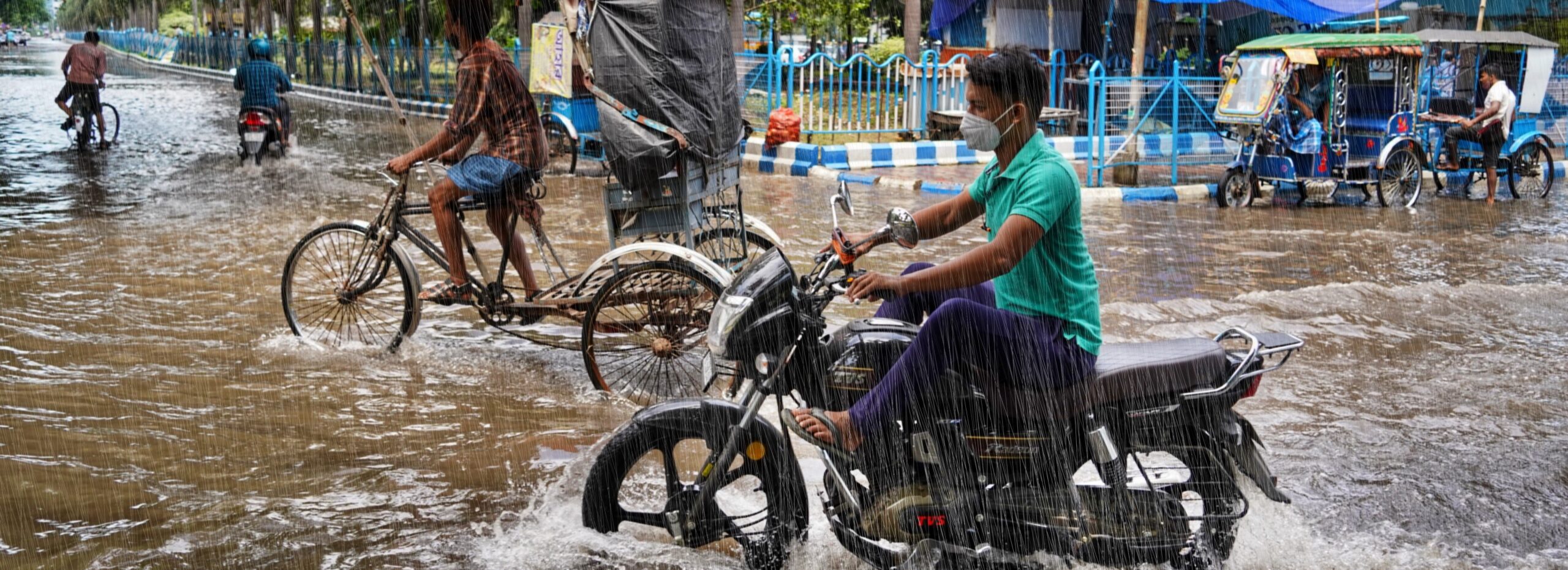
Heavy rainfall triggered widespread inland and river floodings and landslides, particularly in Chiba Prefecture (MLIT, 2026). A road collapsed in Chiba City, and inundated or flooded roads were reported across at least 28 municipalities. Additionally, embankments surrounding Lake Inbanuma were breached at three locations, flooding nearby areas (Japannews, 2026). The storm also disrupted essential infrastructure, leaving nearly 45,000 customer accounts without electricity across the Tokyo Electric Power Company’s service area (Watchers, 2026). According to the latest reports, Typhoon Dujuan was associated with 17 deaths across the affected regions, including 10 fatalities in Chiba Prefecture alone (FDMA, 2026), primarily as a result of landslides.
In this study, scientists from Japan, United States, United Kingdom, Ireland and the Netherlands, use several approaches to investigate the influence of climate change on different aspects of Typhoon Dujuan.
For the assessment of the role of climate change in the heavy rainfall we focus on the two days with the most extreme rainfall on the most affected region in which impacts were reported. The most affected region has a broadly consistent elevation and climatology, covering the Kantō region that encompasses the most affected prefectures (Fig. 1, bold black outline). In addition, we also analyse the water vapour content of the atmosphere, also known as precipitable water, over the same timeframe but using a slightly larger region, including parts of the nearby seas (Fig. 1, solid red box). The aim of studying precipitable water is to assess the effect of climate change on the amount of water vapour available in the atmosphere that could potentially fall as rain.
To study the conditions that formed and fuelled Dujuan, we also analyse the role of climate change as well as El Niño on the high sea surface temperatures that fueled the storm, evaluating trends in average August-October SSTs over the region from 30N-41N, 129E-148E (Fig. 1, dashed red box).
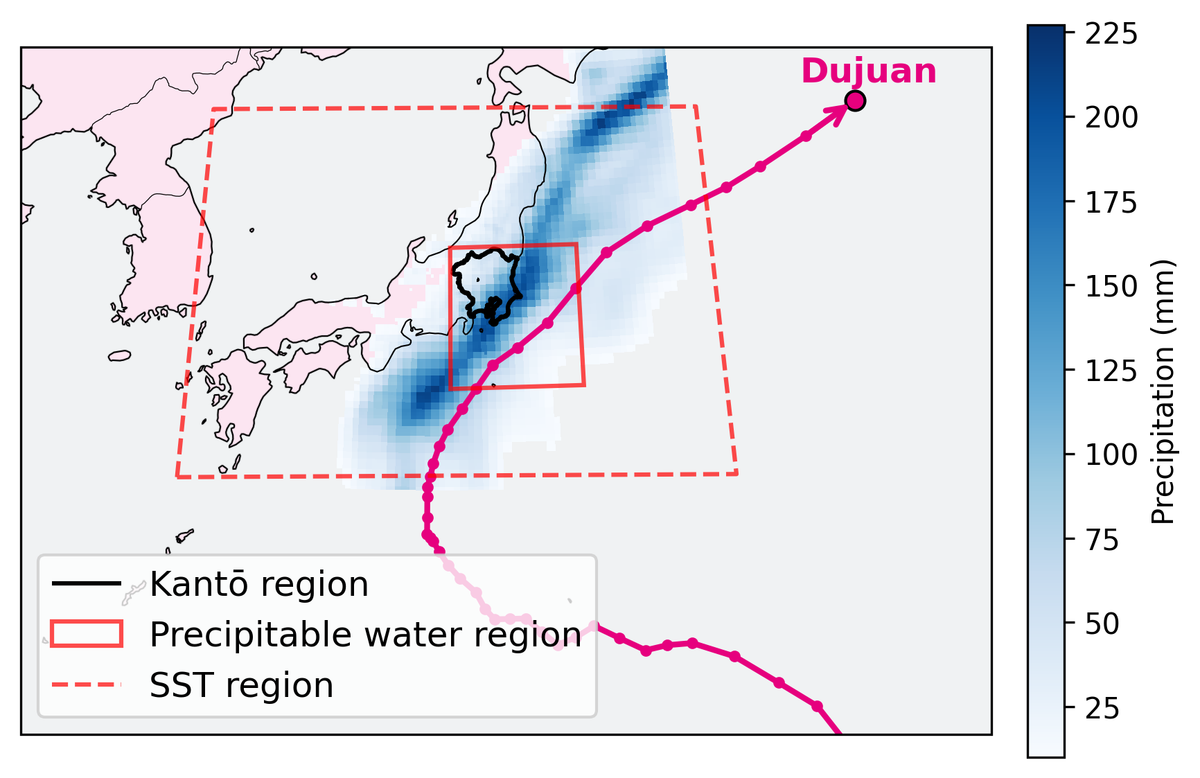
Figure 1: Track of typhoon Dujuan along the Japanese coast and maximum 2-day rainfall along the coast. The Kantō region is outlined in black; solid red box denotes study region for precipitable water vapour; dashed red box denotes study region for SSTs. (Data sources: MSWX, IBTrACS)
Main findings
- Typhoon Dujuan brought heavy rainfall, flooding and landslides to Chiba and surrounding areas in Japan, disrupting transport, electricity and essential services. Older adults and those reliant on care were particularly at risk. Repeated flooding and infrastructure damage further worsened existing problems, highlighting how location, land use and social inequalities shape the impact of disasters.
- The rainfall associated with Typhoon Dujuan in the Kantō region is a common event in today’s climate, with similar rainfall totals expected approximately every three years, although local return periods were much higher with the rainfall on e.g. Oshima island having a return time of about 20 years, Funabashi and Abiko in Chiba prefecture about 60 years and Miura in the Kanagawa prefecture about 150 years.
- To estimate if human-induced climate change influenced the heavy rainfall, we first determine if there is a trend in the observations. Observation-based datasets suggested that over the historical record, such rainfall extremes have become more likely and intense as the world has warmed, the uncertainties are however very high, making quantification difficult.
- To determine the role of climate change in the rainfall, we combine observations with climate models. The models exhibit substantial uncertainty, with some projecting pronounced increases in heavy precipitation and others indicating little or no change. This large uncertainty, together with the spatial resolution limitations of both climate models and gridded observational datasets, constrains our ability to quantify the influence of climate change on the rainfall event using the probabilistic attribution method.
- Repeating the same analysis for precipitable water – the amount of water available in the atmosphere that could potentially fall as rain – we find strong and consistent trends in both observations and climate models, suggesting an increase in the amount of water vapour of 9% attributable to human-induced climate change, consistent with what we would expect from the Clausius Clapeyron relation.
- In addition to rainfall and water vapour, we analyse the very warm sea surface temperatures (SSTs) over which Dujuan passed before reaching peak intensity were around 2-3°C hotter than in a preindustrial climate.
- In these analyses we also tested whether El Niño affected the event, using different ways of defining the phenomenon. In all cases we found that El Niño did not intensify the rainfall or increased sea surface temperatures.
- Using a separate analysis of Typhoon Dujuan-like events selected based on the spatial distribution of precipitable water in climate model simulations, we find a 20-40% increase in rainfall in the locations that received the highest rainfall in this event under present-day compared to pre-industrial climate conditions. An analysis by a Japanese government research team using a different methodology and event definition also found a rainfall increase of over 20% attributable to global warming.
- By selecting Typhoon Dujuan-like events from climate model simulations based on their tracks and comparing them under present-day and pre-industrial climates, we find a slight increase in wind intensity but no statistically significant change in frequency.
- Synthesising evidence from these different approaches, we find that anthropogenic global warming has had a relatively limited influence on the frequency and intensity of the typhoon itself, while its contribution to the rainfall associated with the combined effects of the typhoon and the autumn rain front appears more pronounced. However, attribution in small, topographically complex regions remains challenging due to limitations in observational data and climate model resolution, highlighting the importance of combining multiple lines of evidence to draw robust conclusions.
- Japan has extensive forecasting capabilities, early warning systems, flood protection infrastructure, established disaster response mechanisms, and a multi-layered social protection system to respond to shocks. However, Dujuan highlights the limits of preparedness, such as when rainfall exceeds design values for infrastructure. It is important to strengthen structural and physical adaptation planning along with social adaptation measures to the increasingly heavy rainfall resulting from typhoons in this region.