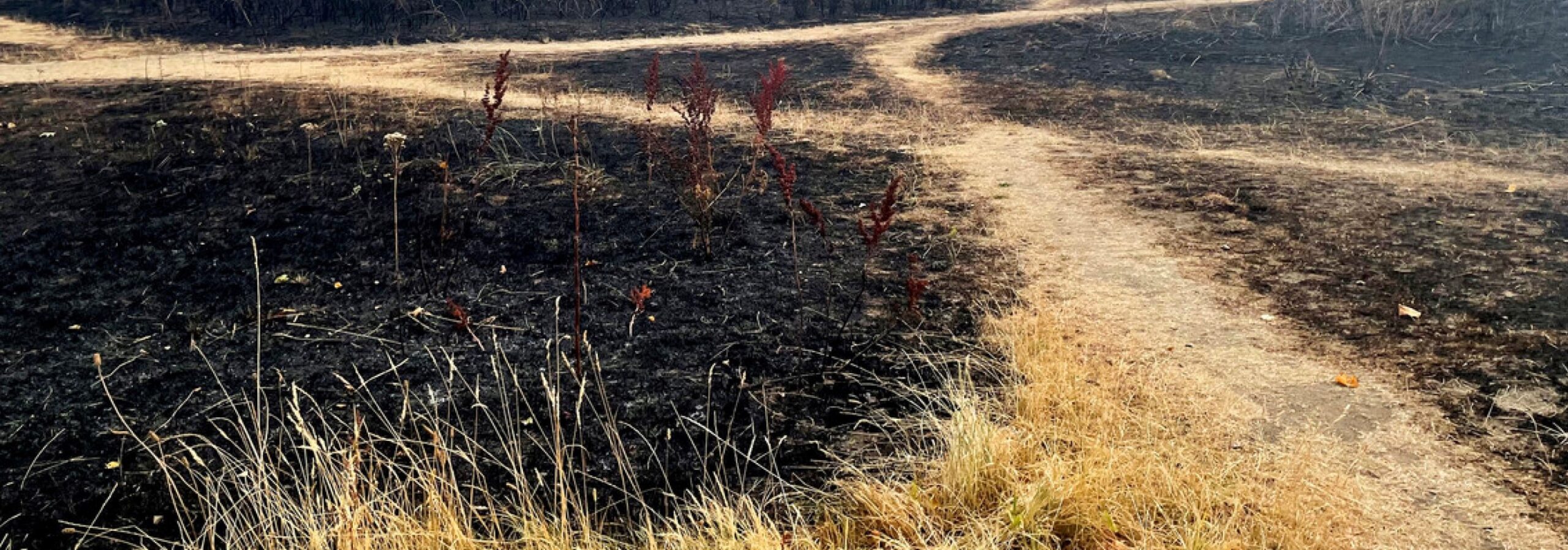

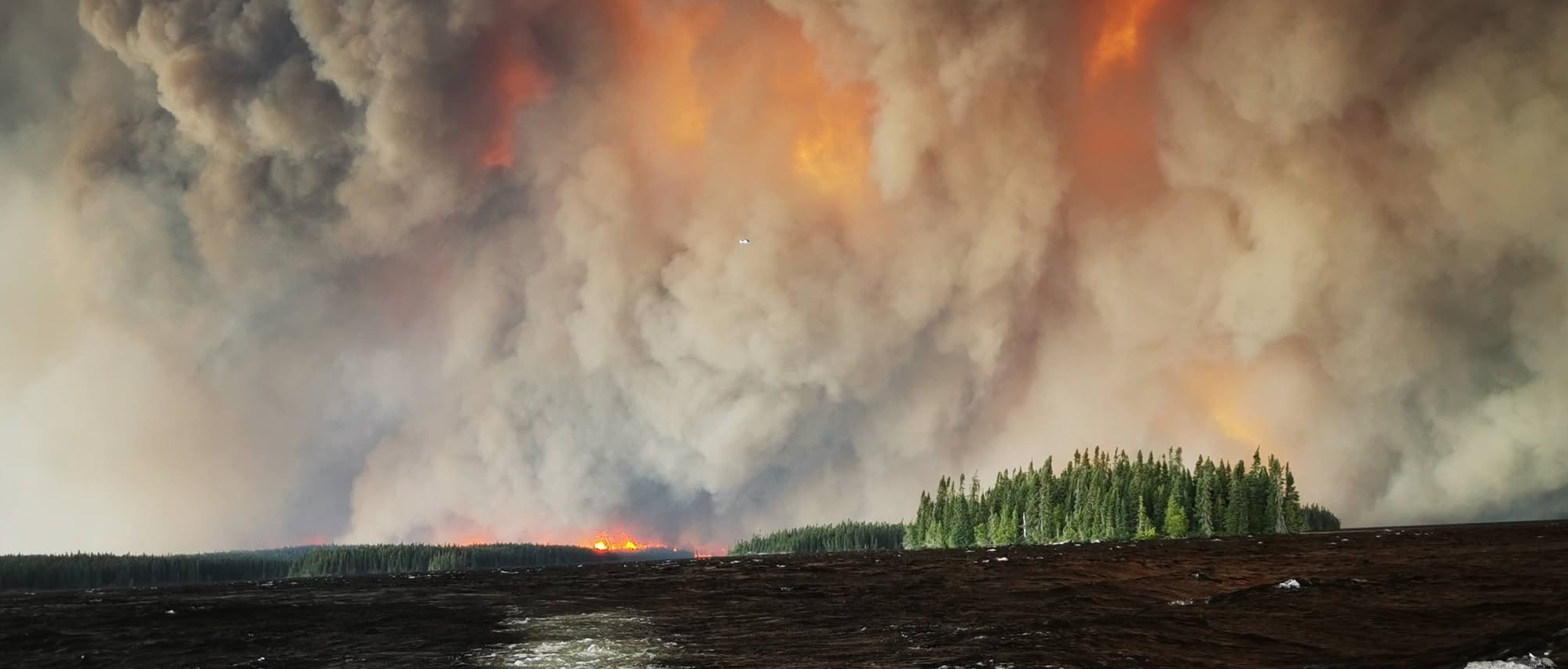
More than 3 million hectares have burned to date (Natural Resources Canada, 2026), prompting a Level 4 National Preparedness response (GoC, 2026, ciffc). Although the season began with below-average wildfire activity, prolonged hot, dry weather through July has driven a rapid escalation in fire activity across the country (CBC, 2026). At the time of writing, Ontario and the Northwest Territories have been especially affected regions in Canada’s 2026 wildfire season, with hundreds of active fires, many of them out of control (The Guardian, 2026).
What was particularly remarkable this year was the exceptionally rapid rate at which burned area accumulated over a very short period of time. Estimates indicate that approximately 94% of the total area burned occurred during the five weeks between end of June and end of July (CWFIS, 2026). Early-season fire hotspots were concentrated in British Columbia and the Northwest Territories, with fire intensity comparable to 2014 and 2023 (Copernicus, 2026). By mid-July, wildfire activity had intensified in Ontario due to extreme heat, dry conditions and strong winds (GoC, 2026). Widespread lightning storms during the week beginning 20 July triggered numerous new fires, while continued high temperatures, low humidity and dry vegetation allowed existing fires to expand rapidly, further challenging suppression efforts (The Guardian, 2026a, Reuters, 2026).
Over 120 million people in the Midwest and Northeast U.S. were affected by dangerous air quality, with alerts stretching from Minnesota to New Hampshire (CNN, 2026). Exposure to elevated concentrations of wildfire smoke has been associated with increased emergency healthcare utilisation, particularly for respiratory and cardiovascular conditions, as well as increases in all-cause mortality (AJMC, 2026), while also prompting public health warnings, large-scale evacuations, disruption to transport and economic activity, and considerable pressure on firefighting resources (Medical Daily, 2026). In particular, many remote and Indigenous communities have been displaced, with some communities suffering extensive damage or destruction as fires spread rapidly under extreme weather conditions (Medical Daily, 2026).
Scientists from Canada, the US, the Netherlands and the United Kingdom collaborated to assess to what extent human-induced climate change altered the likelihood and intensity of the weather conditions at the time of the fires, and how the conditions will be affected with further warming.
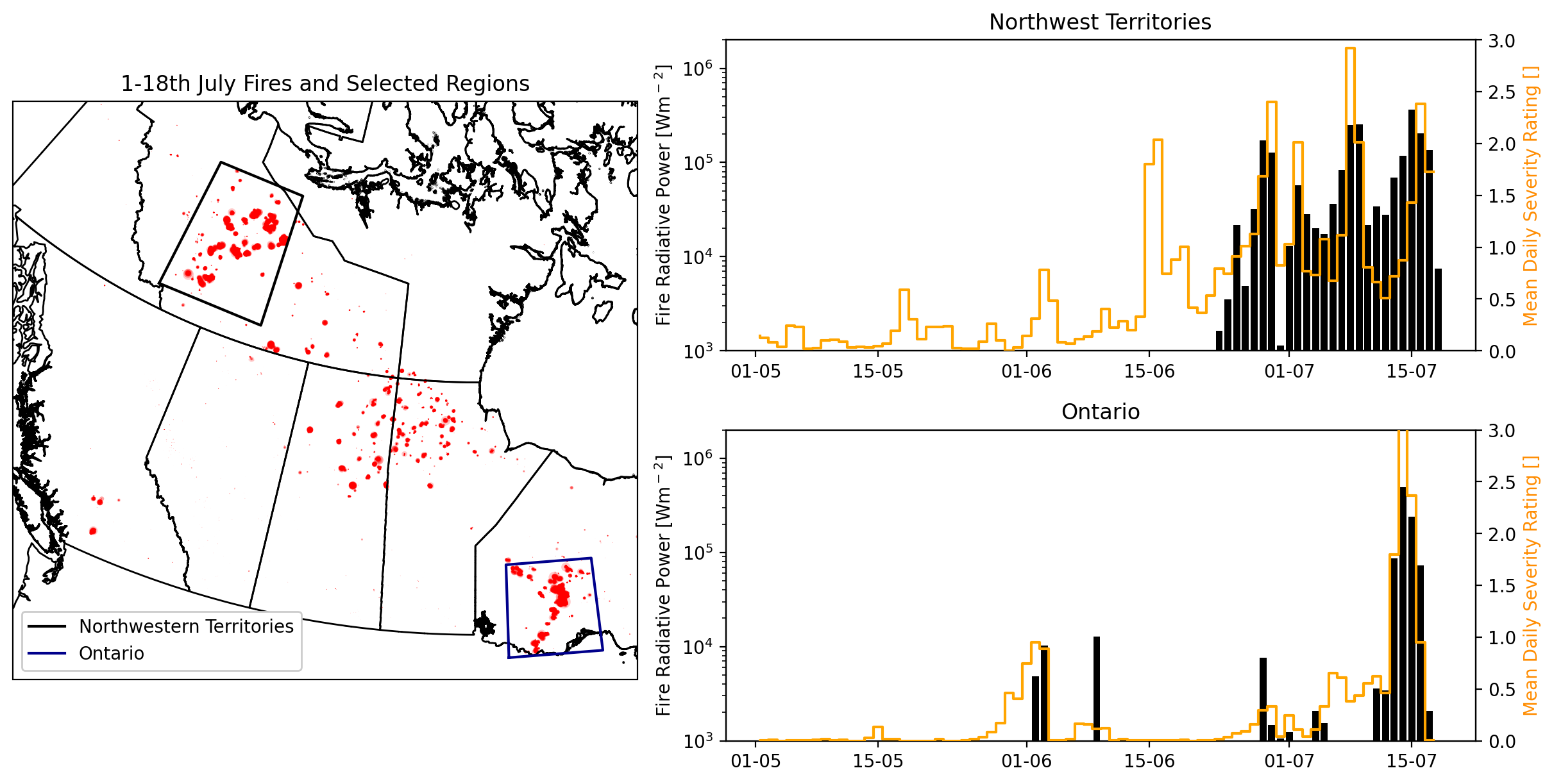
Figure 1: left, detected FRP activity (VIIRS) for July 1-18th with the event study regions overlaid. Right, fire activity characterised in black bars (FRP) and the spatially averaged daily severity rating in orange lines (DSR) for the Northwest Territories (top) and Ontario (bottom) regions.
|
To capture the extent and duration of the extreme fire weather across the region, we use the cumulative Daily Severity Rating (DSR). The DSR is a scaled power transformation of the Canadian Fire Weather Index (FWI), and reflects how difficult a fire is to suppress once ignition has occurred; it is commonly used for assessing fire weather on multi-day timescales. Both indices (FWI and DSR) have been used extensively to characterize fire weather in Canada (e.g. Jain et al., 2024, Barnes et al., 2025). Here we focus on the DSR for the 7 days of most intense fire weather conditions (henceforth DSR7x) and the monthly value, DSR30x in the regions of the worst fires in the Western Territories and Ontario ( Fig. 1). In addition we analyse the 24 months effective precipitation (rainfall minus potential evapotranspiration) to assess the role of climate change in the drought conditions preceding the fires. |
Key Messages
- Indigenous communities and wildland firefighters face heightened physical and mental health impacts from wildfires. Indigenous communities are overrepresented in wildfire areas, while remote locations and limited transportation routes have made evacuations more difficult. Successive wildfires have made long-term recovery between disasters more difficult. Beyond physical impacts, repeated evacuations and displacement can disrupt access to hunting grounds, traditional foods and cultural practices.
- The large numbers of simultaneous fires across Canada and their rapid growth under extreme fire weather conditions are stretching available personnel and firefighting resources (e.g. aircraft, equipment) and resulting in extensive impacts to property and public health.
- The impacts of wildfires reach far beyond the location of the fire itself. Smoke from the fires affected millions of people over hundreds of kilometers. Wildfires can cause severe and often delayed health impacts ranging from difficulty breathing to cardiac arrest. Compounding vulnerabilities (e.g. preexisting conditions, socioeconomics) and concurrent extreme weather events can increase the likelihood of negative health outcomes.
- In the Northwest Territories, DSR7x as observed in July 2026 had a return period of 2 years, but DSR30x is of more relevance to the sustained fire activity seen in the region and had a return period of 6 years. In observations, these events would have been much rarer in a 1.4°C cooler climate with return periods of 50 and 100 years for this year’s 7-day and 30-day event.
- In Ontario, very rapid spread and establishment of the fires means that DSR7x is of greater relevance, with a 15 year return period in today’s climate, made a factor of about 3.5 more likely with 1.4°C of global warming. DSR30x had a return period of 6 years, and is observed to have increased in likelihood by a factor of about eight.
- To assess the role of human-induced climate change we combine the observation-based assessments with climate models. In both regions and for both event definitions the climate models show a much smaller increase in likelihood and intensity. Combining models and observations gives an increase in likelihood of about a factor of 5 in the Northwest Territories for DSR7 and a factor 2 for DSR30 and in Ontario of about 2 for both event definitions.
- In addition to the weather conditions at the time of the outbreak, we also analyse effective precipitation for the 2-year period preceding the fires. In observations we find the change in intensity of effective precipitation compared to a 1.4°C cooler counterfactual climate is small and very uncertain in both regions. There is also no evident trend in the climate models, thus we cannot attribute a change in 24-month dry conditions to human-induced climate change. This lack of trend in long term drought does not necessarily apply to the rapid onset of drought at shorter timescales, which is included as a factor in the drought code component of the DSR.
- Canada’s forests are highly susceptible to wildfire because of their natural fuel characteristics and climate conditions. As wildfires become more frequent, larger, and more intense, fuel reduction measures become less effective and fires become increasingly difficult to control.
- Sustaining an effective response through the remainder of the fire season will require continued interagency coordination, flexible deployment of personnel and equipment across jurisdictions, and sufficient surge capacity to respond to new large fires without compromising ongoing operations. Adaptation to increasing wildfire risk requires an integrated risk management approach and can include incorporating future fire risk into timber harvest allocations, improving forest resilience after fires occur by diversifying with less flammable tree species, as well as strengthening early warning systems and implementing multi-risk zoning for land use and development planning that can have multiple benefits. Integrating First Nation’s knowledge and experience strengthens risk assessment, preparedness and response.
- The last three fire seasons in Canada have been exceptionally severe, with record-breaking burned area and emissions recorded across multiple regions. In 2023, WWA found that the severe start to the fire season in Quebec was made seven times more likely due to human-caused climate change. Since then, a growing body of peer-reviewed research has established that climate change is driving the increasing severity of extreme Canadian fire seasons.