
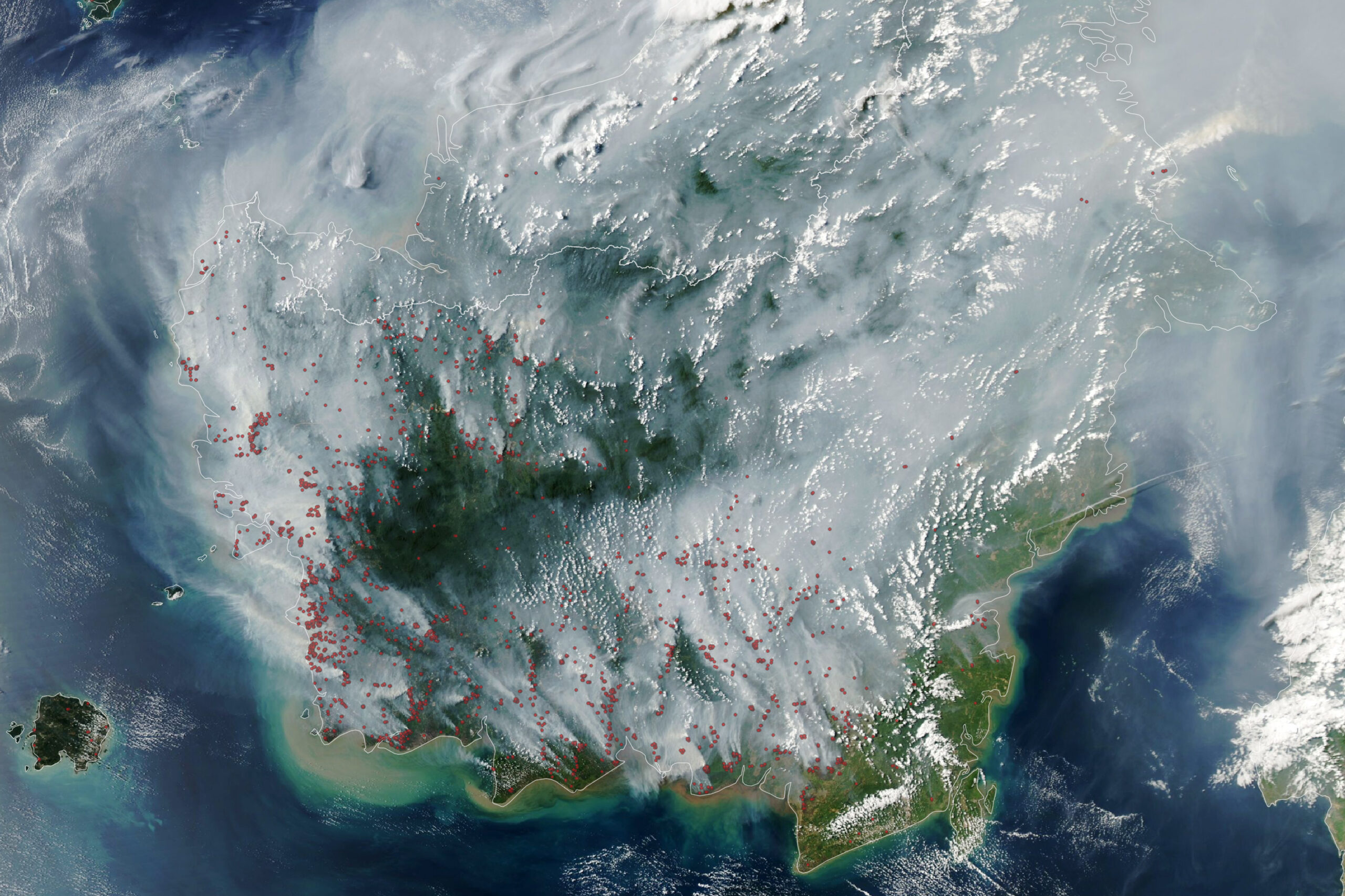
Between August and October 2026, western Indonesia experienced widespread fire activity during an exceptionally hot and dry season, coinciding with a strong El Niño event. Historically, El Niño has been strongly associated with severe fire seasons in Indonesia, with the major events of 1997 and 2015 both characterised by exceptionally high fire activity (ABC News, 2026). The 2026 fire season also coincided with record-breaking temperature extremes and historically low seasonal rainfall, creating particularly dry conditions across the region (Reuters, 2026).
During the season, fires were concentrated particularly in Sumatra and Kalimantan, with West and Central Kalimantan among the worst-affected regions. By September 2026, approximately 1,9 million hectares had burned nationwide, making 2026 one of Indonesia’s worst fire seasons since 2015 (Nusantaras Atlas, 2026). By mid-October, Central Kalimantan and South Sumatra accounted for the largest shares of national fire emissions (Katadata, 2026).
The fires had considerable environmental and social impacts across Indonesia and neighbouring countries. By November, authorities had reported over 400,000 respiratory infections associated with the fires (Antara, 2026), with an estimated 12.5 million people exposed to haze across Indonesia, Malaysia, Singapore, and Timor-Leste (BBC, 2026; The Straits Times, 2026). Smoke spread across Southeast Asia, affecting air quality in Malaysia, Singapore and the Philippines, prompting school closures and disrupting transport, including flights in Kalimantan (ABC News, 2026, Associated Press, 2026). By October, the fires had also contributed to substantial greenhouse gas emissions, with 2026 emissions approaching levels recorded during the severe 2015 fire season (Carbon Brief, 2026).
Scientists from Indonesia, the US, the Netherlands, Sweden and the United Kingdom collaborated to assess to what extent human-induced climate change altered the likelihood and intensity of the weather conditions at the time of the fires, and how the conditions will be affected with further warming. We focus on three regions on Borneo, Sumatra and Java (blue outlines, Fig.1) and three different variables to capture various aspects of the extreme fires: (1) VPDx7x, which is the annual maximum of the 7-day rolling average of daily maximum vapour pressure deficit (VPD). It is used in climate and wildfire-risk analysis to identify sustained periods of hot, dry air. (2) the low precipitation during the July to October season, calculated as the precipitation totals of that season; and (3) the August to October seasonal temperatures. Given the strong El Nino conditions, we assess both the role of climate change and El Nino, using the Relative Oceanic Niño Index (RONI). As the results from all three regions are very similar, we combine them for the numerical analysis.
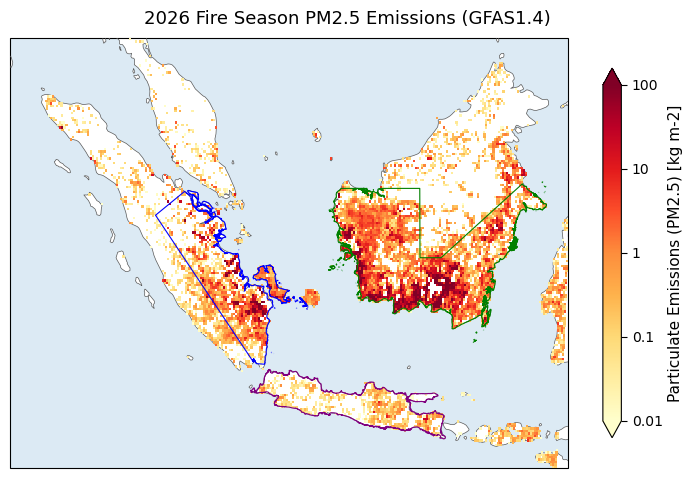
Figure 1: PM2.5 (particulate matter less than 2.5 µm in diameter from August-October 2026, sourced from GFAS1.4) emissions this fire season – associated with higher health impacts from smoke.
Main Findings
- The fires have burnt 1,9 million hectares of land, but impacts reach far beyond the locations of the fires themselves. Associated smoke affected 12.5 million people across Indonesia, Singapore, Malaysia, and Timor-Leste. and contributed to 400,000 cases of respiratory infections in Indonesia alone. Wildfires can cause severe and often delayed health impacts ranging from difficulty breathing to cardiac arrest. Compounding vulnerabilities (e.g. preexisting conditions, socioeconomics) and concurrent extreme heat events, as occurred this year, can increase the likelihood of negative health outcomes.
- The wildfires have also destroyed orangutan habitats, restricting access to food and forcing critically endangered orangutans into plantations and settlements, increasing human-wildlife conflict. In Java, fires damaged habitats of other threatened species such as the Sunda pangolin and Javan leopard.
- Deforestation, logging and agroforestry expansion have substantially reduced Indonesia’s tropical and peat swamp forests, and are associated with fire use for land clearance, while peatland drainage increases fire susceptibility by drying carbon-rich peat. Between 1990 and 2010, peat swamp forest cover declined by approximately 45% in Borneo and 63% in Sumatra, with a further 1.4 million hectares of forest on peatlands lost across Indonesia between 2009 and 2019.
- All three regions analysed show a very similar response to ENSO, and while they are different with respect to vegetation, there are no Peatlands on Java, qualitatively the fire weather conditions are very similar. We therefore combine the three regions in the analysis below.
- Both rainforest and peat land fires are highly drought driven, and to assess these conditions we looked at the July to October rainfall totals that controlled fire season moisture supply. The other component of the seasonal drought is brought by warm, drying conditions. We assessed the main contribution of this through fire season temperatures. In addition, we also assess VPD7x, which characterises short-term hot-dry events that often lead to a fire starting. All three measures are influenced by ENSO and climate change, while the ENSO signal dominates in rainfall and is about the same size as the climate change signal in VPD7x, human-induced climate change is by far the biggest contributor to this year’s seasonal temperatures.
- Precipitation in observation datasets showed a very strong relationship with ENSO, with the current El Niño estimated to have decreased the intensity of this year’s seasonal rainfall by about 50%. Human caused climate change also shows an emergent decreasing effect on this year’s rainfall of about a 15% reduction in rainfall.
- Climate models also represent the strong effect of El Niño, but do not show the climate change response that we see in observations.
- When assessing seasonal temperatures, we find broad agreement between observations and climate models. The assessment shows that climate change has driven a substantial increase in temperatures by several orders of magnitude in likelihood and about 1.6°C in intensity, while ENSO has had a smaller increasing effect, but consistent in observations and models, of about a factor 11 and 0.3°C in intensity. Thus, for temperatures we find a small influence of the current El Nino but a very large increase in the likelihood and intensity of 2026-like conditions attributable to human-induced climate change.
- Fire activity in vegetation responds strongly to short term hot-dry extremes. The 7-day maximum VPD return period estimates suggest that the conditions observed in August–October 2026 are relatively common under similar ENSO conditions. Observations and climate models broadly agree, but models show overall slightly smaller trends. Combining both models and observations we find that these conditions have become approximately 3 times more likely due to human-induced warming, with VPD intensity increasing by around 0.4 kPa. The ongoing El Niño also increased the likelihood of these conditions by approximately 5 times, with VPD intensity increasing by around 0.6 kPa. These are conservative numbers as they also include models that do not represent the ENSO index well.
- The contribution of El Niño and climate change to increasing the severity of fire weather in Indonesia also means that these conditions are increasingly predictable, creating an opportunity for proactive risk reduction measures. Reducing landscape fire risk involves addressing the conditions that contribute to fire ignition and spread, particularly in drained peatlands and degraded forests. Relevant measures include peatland restoration and preservation and maintaining higher water tables (e.g., blocking canals, reducing drainage, etc.), protecting remaining forest areas, reducing deforestation and incentivising land-management practices that reduce reliance on burning. While these measures would already reduce smoke pollution, additional priorities could include strengthening air quality monitoring and public health warnings as well as measures to limit smoke exposure and protect vulnerable populations, particularly during severe haze episodes.